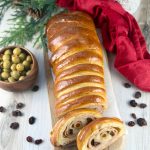
Sourdough Pan de Jamón (Venezuelan Christmas Bread)
Soft, slightly sweet Venezuelan Christmas bread made with active sourdough starter and filled with ham or turkey, green olives, and raisins. Finished with a glossy papelón glaze.
Servings 2 loaves
Calories 3074kcal
Ingredients
For Bread
- 465 g bread flour
- 150 g sourdough starter active
- 180 g milk lukeward
- 95 g sugar
- 2 eggs large
- 100 g butter, unsalted softened
- 9 g salt
For Papelon Syrup
- 50 g grated papelón or dark brown sugar
- 25 g water
For Filling
- 900 g thinly sliced smoked ham
- 120 g raisins
- 160 g pitted green olives sliced and well drained
For Finishing
- 1 egg lightly beaten
Instructions
For Papelon Syrup
- Combine the grated papelón and water in a small saucepan. Heat gently until dissolved and slightly syrupy. Remove from heat and cool completely. We w
For Dough
- Feed your starter early enough that you have 150 g of active starter at or near peak when mixing. It should be bubbly, expanded, and smell pleasantly yeasty, without a sharp acidic aroma.
- In the mixer bowl, combine the milk, active starter, sugar, and eggs.Add the bread flour and mix on low speed until a shaggy dough forms.Cover and rest for 15–20 minutes.
- Add the salt, then gradually incorporate the softened butter in several additions.Knead on low speed until the dough is smooth, elastic, and passes a windowpane test. This may take approximately 10–15 minutesThe finished dough should be soft, supple, and slightly tacky, but manageable.Important: Don't add extra flour simply because the dough initially feels sticky. Give the butter time to incorporate and the gluten time to develop.
- Transfer the dough to a lightly greased container. Cover and ferment at approximately in a warm place. Aim for 40–50% increase in volume, rather than doubling. Estimated time: 4–6 hours
- Once the dough reaches the target rise, refrigerate covered for 10–14 hours
- Remove the dough from the refrigerator. Divide into two equal pieces, approximately 500 g each.Let the dough rest for 20 minutes, just until pliable enough to roll.On a lightly floured surface, roll each piece into a rectangle approximately 12 × 16 inches, aiming for about ⅛-inch thickness.If the dough springs back, cover and rest for 10 minutes before continuing.
- Brush each rectangle with a very thin layer of cooled papelón syrup.Distribute half the ham over each rectangle, followed by half the raisins and olives. Leave approximately 1 inch uncovered along the edge where you'll seal the loaf.Avoid thick piles of ham or excess syrup, which can interfere with even baking
- Roll from the shorter side to create a loaf approximately 12 inches long.Roll evenly and snugly enough to hold its shape, but do not compress the filling.Pinch the seam and ends closed. Place seam-side down on a parchment-lined baking sheet, leaving plenty of space between the loaves.Prick the top of each loaf several times with a skewer to allow steam to escape
- Cover loosely and proof until the loaves look noticeably puffy and feel lighter.Estimated time:3-5 hours, possibly longer. The dough should have visibly expanded, but it doesn't need to double.
- Preheat the oven to 325°F (163°C).Brush the loaves lightly with egg wash.Bake on the middle rack, beginning to check around 40 minutes.For this first test, budget approximately 45–60 minutes, although the actual time may differ.Tent loosely with foil if the crust browns too quickly.Check the thickest dough section with an instant-read thermometer. Aim for approximately 190–195°F
- Remove from the oven and brush lightly with more papelon syrup while warm, Cool for at least 60 minutes before slicing.
Notes
Sourdough Starter: Use an active, bubbly sourdough starter at 100% hydration. I used Betty, my regular starter.
Fermentation: This is an enriched dough containing milk, butter, eggs, and sugar, so it may take longer to rise than traditional sourdough. Always watch the dough rather than relying strictly on the clock.
Overnight Refrigeration: Refrigerate the dough unfilled after bulk fermentation. The cold dough is easier to roll and shape the following day.
Rolling the Dough: Roll the dough thinly and evenly to avoid thick, bready layers in the finished loaf.
Filling: I used approximately 1 pound of thinly sliced turkey per loaf. Traditional ham or pastrami are also delicious alternatives. Distribute the olives and raisins evenly for the best flavor in every slice.
Papelón Syrup: Brush a thin layer inside the dough before rolling, and reserve some to brush over the bread immediately after baking for a beautiful glossy finish. Brown sugar can be substituted if papelón is unavailable.
Baking: If the bread browns too quickly, loosely tent it with aluminum foil. Allow it to cool before slicing so the spiral holds its shape.
Storage: Refrigerate leftovers in an airtight container for up to 3–4 days, or freeze tightly wrapped slices for up to 2–3 months for best quality.
Nutrition
Serving: 1loaf | Calories: 3074kcal | Carbohydrates: 307g | Protein: 141g | Fat: 142g | Saturated Fat: 59g | Polyunsaturated Fat: 14g | Monounsaturated Fat: 58g | Trans Fat: 2g | Cholesterol: 643mg | Sodium: 8807mg | Potassium: 2287mg | Fiber: 13g | Sugar: 75g | Vitamin A: 2071IU | Vitamin C: 3mg | Calcium: 293mg | Iron: 9mg
